


MoveShepherd imagery (Source: Pexels).
The United States (Remote)
MoveShepherd
Service Design
Design & Research
2 years | 2023 to 2025
MoveShepherd is a two-sided moving-services platform designed to bring clarity, trust, and operational efficiency to one of the most fragmented service industries in the U.S. The project reimagines how individuals plan and manage household moves while giving moving companies a modern, centralized system to handle quotes, workflows, payments, and client communication.
Grounded in design research and extensive usability testing, the platform introduces dual user modes—Customer and Moving Company—each with tailored value propositions.
✺ Led the full end-to-end design process over two years as the sole UX/Product Designer;
✺ Conducted multi-method research to uncover pain points across the service's context;
✺ Designed the core product flows, interaction patterns, and mid- to high-fidelity prototypes for both sides of the platform;
✺ Partnered closely with the founding team to iterate on business requirements, refine project scope, and prepare the platform for handoff into long-term development.
Moving is consistently ranked as one of life’s most stressful events, yet the burden isn’t only on the people relocating. The $86B U.S. moving industry is fragmented, opaque, and technologically outdated, creating challenges on both sides of the experience.
For customers, the lack of transparency, inconsistent pricing, and limited protection create an environment of uncertainty and vulnerability — reflected in the $3.3B in fraud losses reported in 2020 alone. Meanwhile, reputable moving companies struggle behind the scenes with a different kind of complexity: juggling quotes, logistics, inventory, payments, dispatching, and communication across an array of disconnected tools.
Early validation (conducted by Dreu Dixon, founder of MoveShepherd) of 48 user interviews and a 6,000-person ad test revealed the same truth from both ends: people want to feel safe, informed, and supported throughout their move, and movers want a simpler, more centralized way to deliver that trust.
Hence, in 2023, MoveShepherd presents me with the following opportunity:
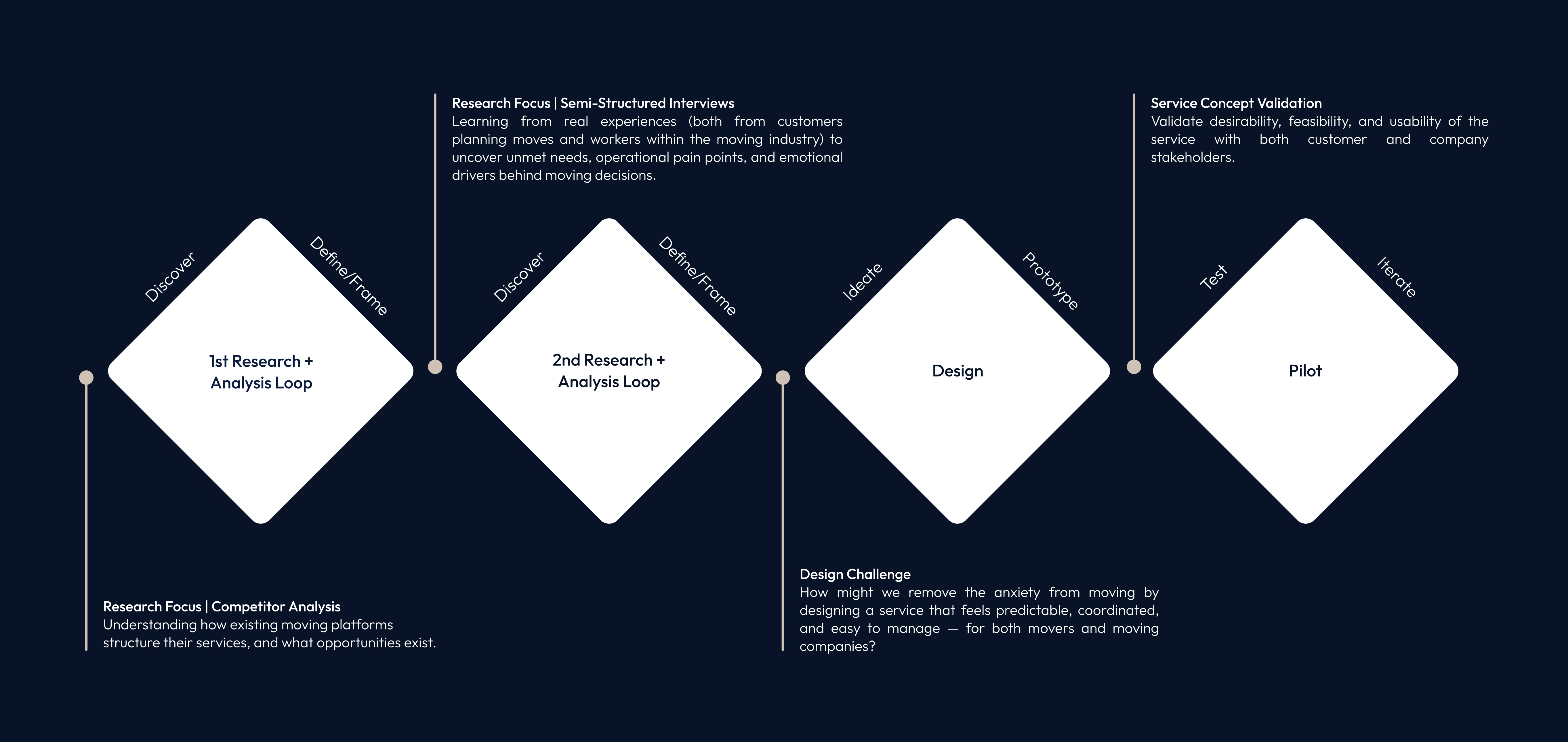
Because moving is a multi-actor service, the research needed to map both the frontstage experience (what moving customers see and feel) and the backstage operations (how moving companies coordinate quotes, inventory, scheduling, and payment across fragmented tools).
Because the service needed to operate at a national scale across the U.S., and because moving involves multiple interdependent layers (logistics, trust, pricing, coordination, and emotional factors) I approached the research from several angles. To understand the problem as a system rather than a single touchpoint, I framed a set of guiding questions that explored the following layers:
I used competitor analysis to establish the current “service baseline”: what the market already offers, what patterns exist across solutions, and where gaps remain. This ensured we didn’t reinvent common patterns—and helped clarify where differentiation could be meaningful.
While competitors offer useful tools — such as cost calculators, moving checklists, and comparative quotes — they fall short in unifying the journey. None provide a seamless, transparent ecosystem that supports both customers and moving companies throughout the entire lifecycle of a move. This gap reveals a strong opportunity for MoveShepherd.
Interviews became a central component of the research because we were exploring a space where no integrated solution currently exists. The competitor analysis made this clear: the market is fragmented, with each platform solving only a narrow slice of the problem.
Conducting interviews also helped counter a major limitation in my position: I was designing for a U.S.-wide service while not residing in the U.S. myself. The country’s scale, regional differences, and variation in moving norms meant I couldn’t responsibly generalize from surface-level research. Speaking directly with people who were preparing to move, as well as professionals with years in the moving industry, allowed me to uncover emotional dynamics, operational constraints, and contextual nuances that would never surface in desk research alone.

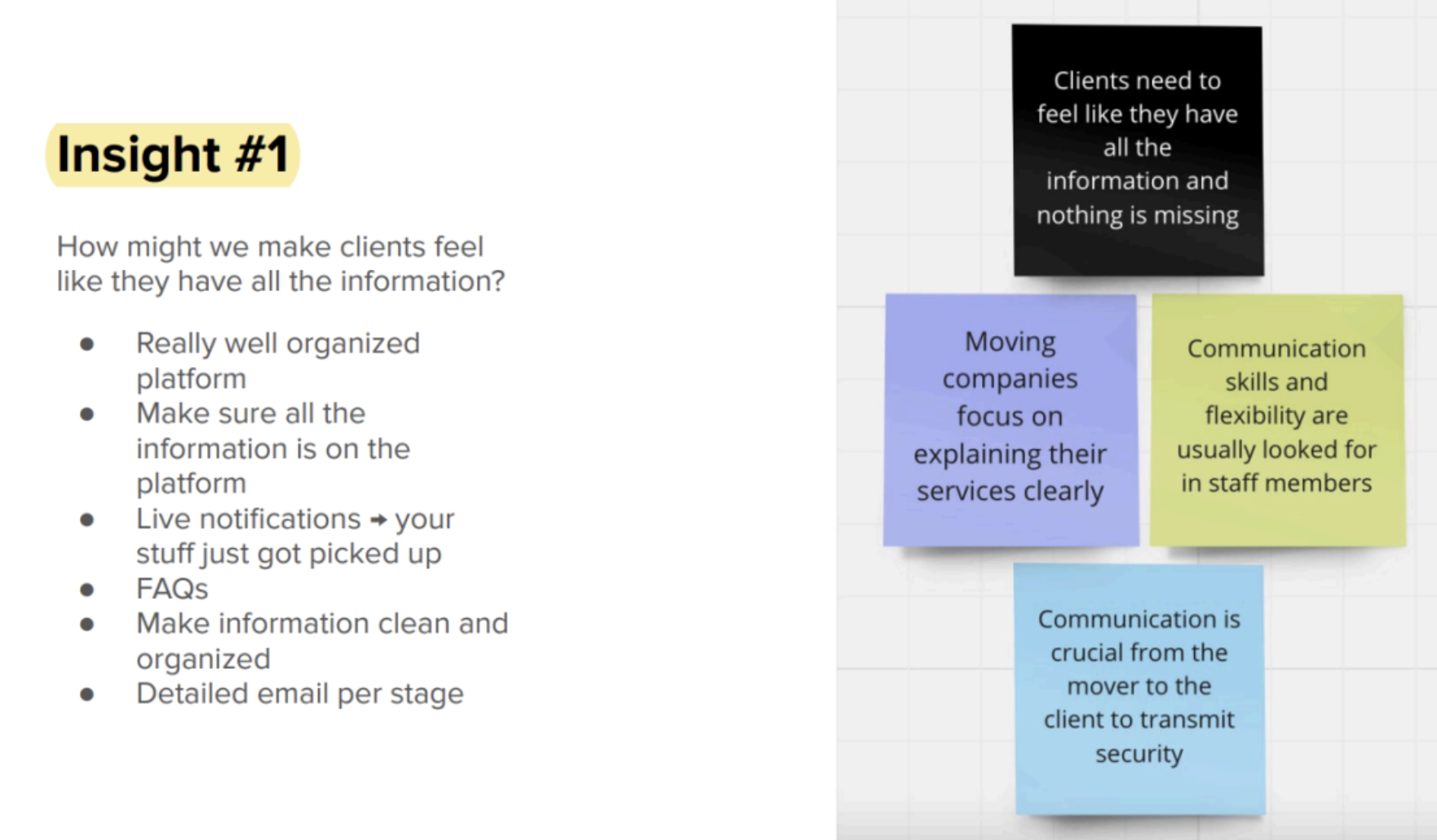
After identifying the insights, I translated each one into a “How Might We…” question to reframe the problem as an opportunity. I then facilitated a structured brainstorming session with the team, using each HMW as an entry point to explore potential design components and service mechanisms.
The goal wasn’t to produce solutions immediately, but to open up the design space to map where interventions could exist and how they might work together.
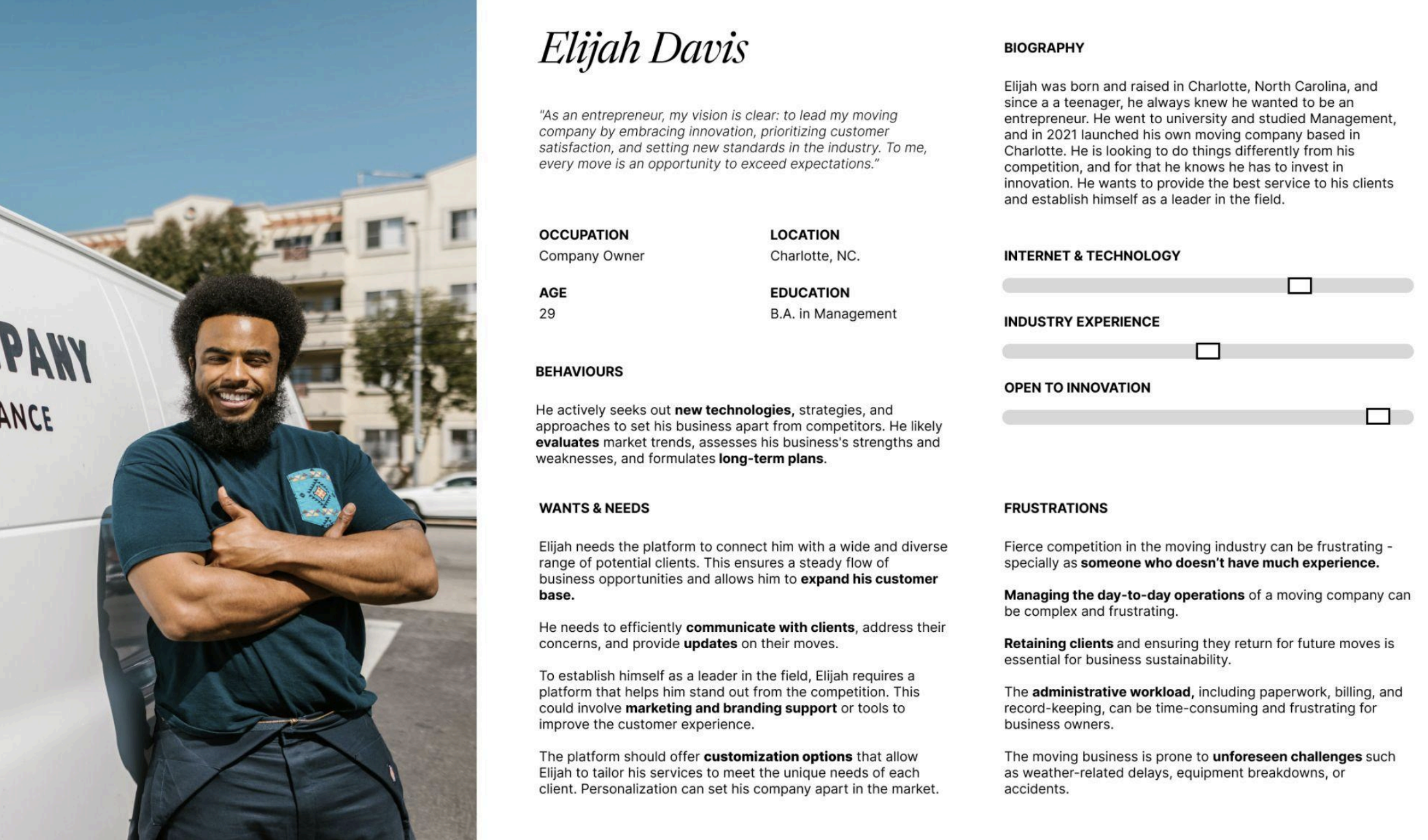
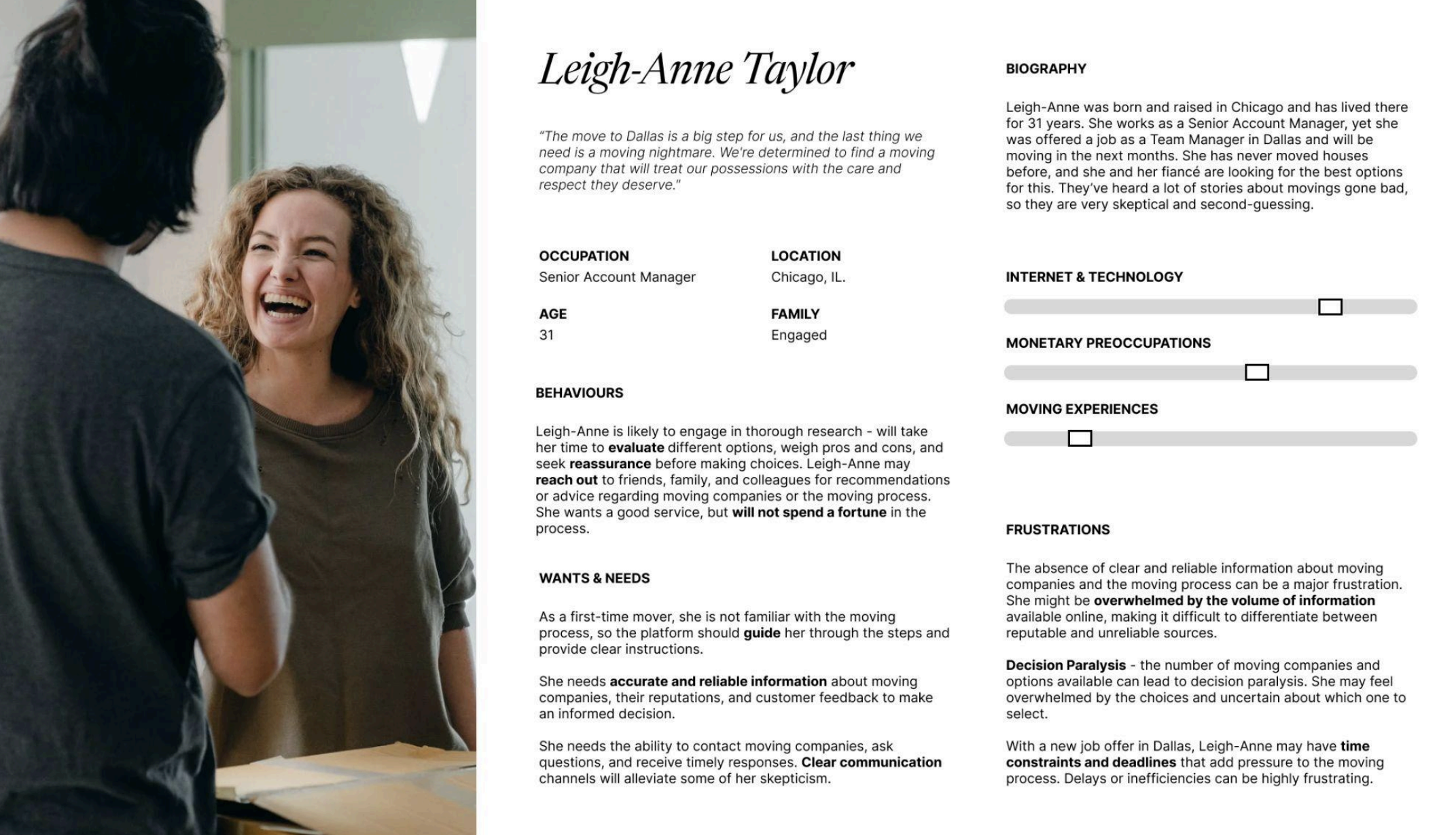
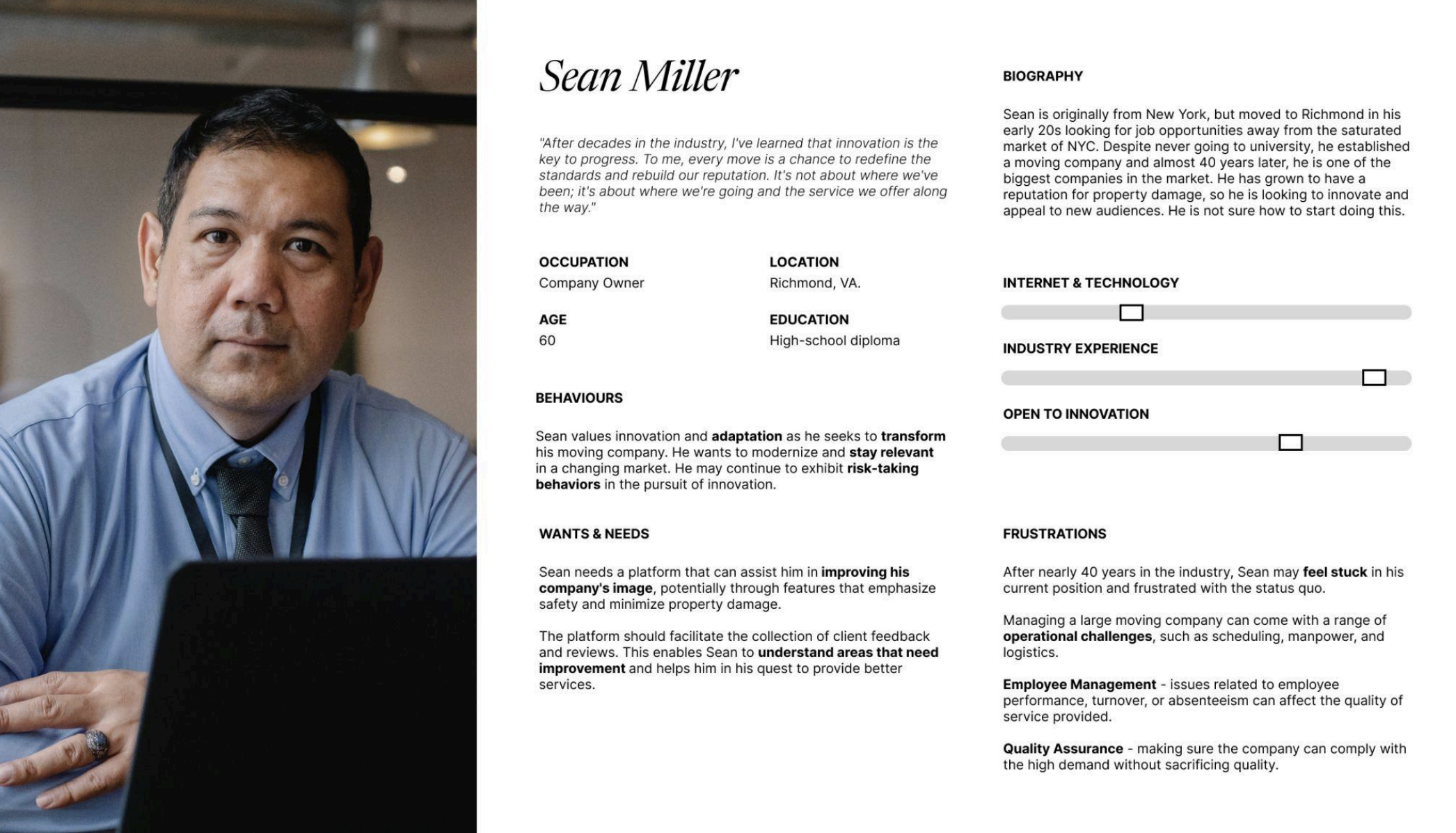
✺ Different levels of emotional vulnerability — from anxious first-time movers to skeptical planners and highly stressed family decision-makers.
✺ Contrasting technological abilities — clients who fear making a mistake on a platform vs. business owners pushing for innovation.
✺ Competing business pressures — from young entrepreneurs seeking differentiation to seasoned owners trying to modernize without losing control.
✺ Divergent definitions of “a good move” — some want reassurance and hand-holding, others value efficiency, clarity, reputation, or customization.

_page-0001.jpg)
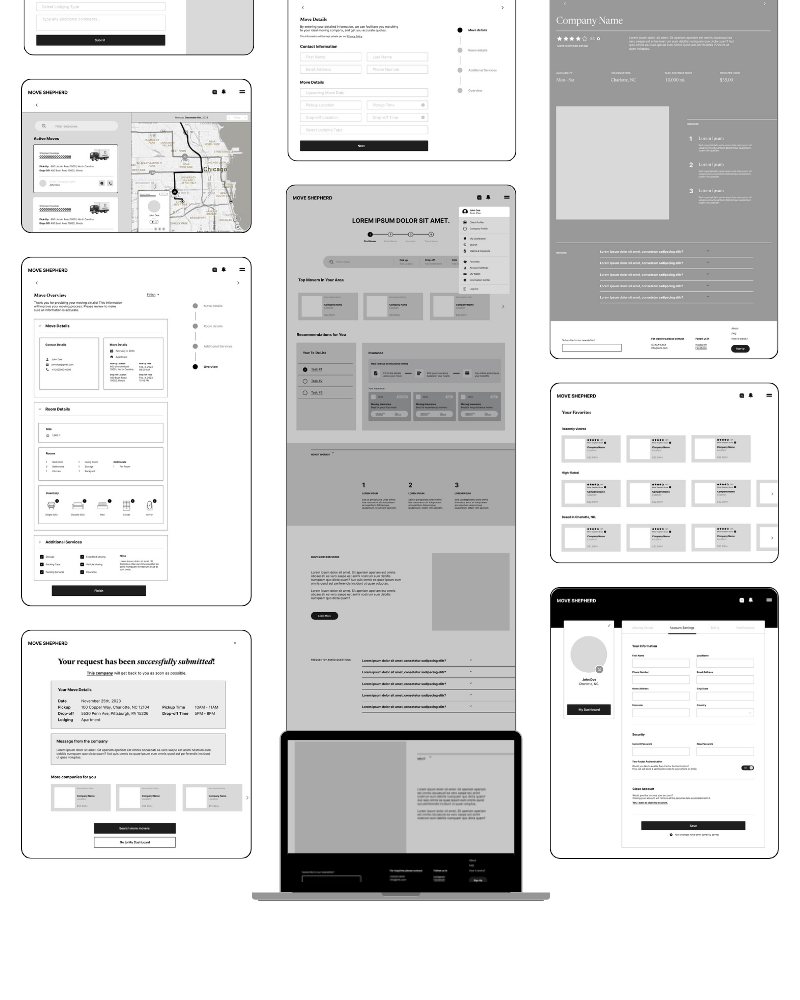
The low-fidelity prototype was developed over several months and shaped through an ongoing, collaborative review process. Each week, I met with the team—which included the founder and the lead developer—to evaluate progress, surface uncertainties, and refine the structure of the experience.
By the time the prototype reached a stable form, it reflected multiple rounds of informed decision-making and alignment across disciplines. At that stage, I moved into remote testing using Lyssna, a platform that enabled structured feedback from users before investing in visual design.
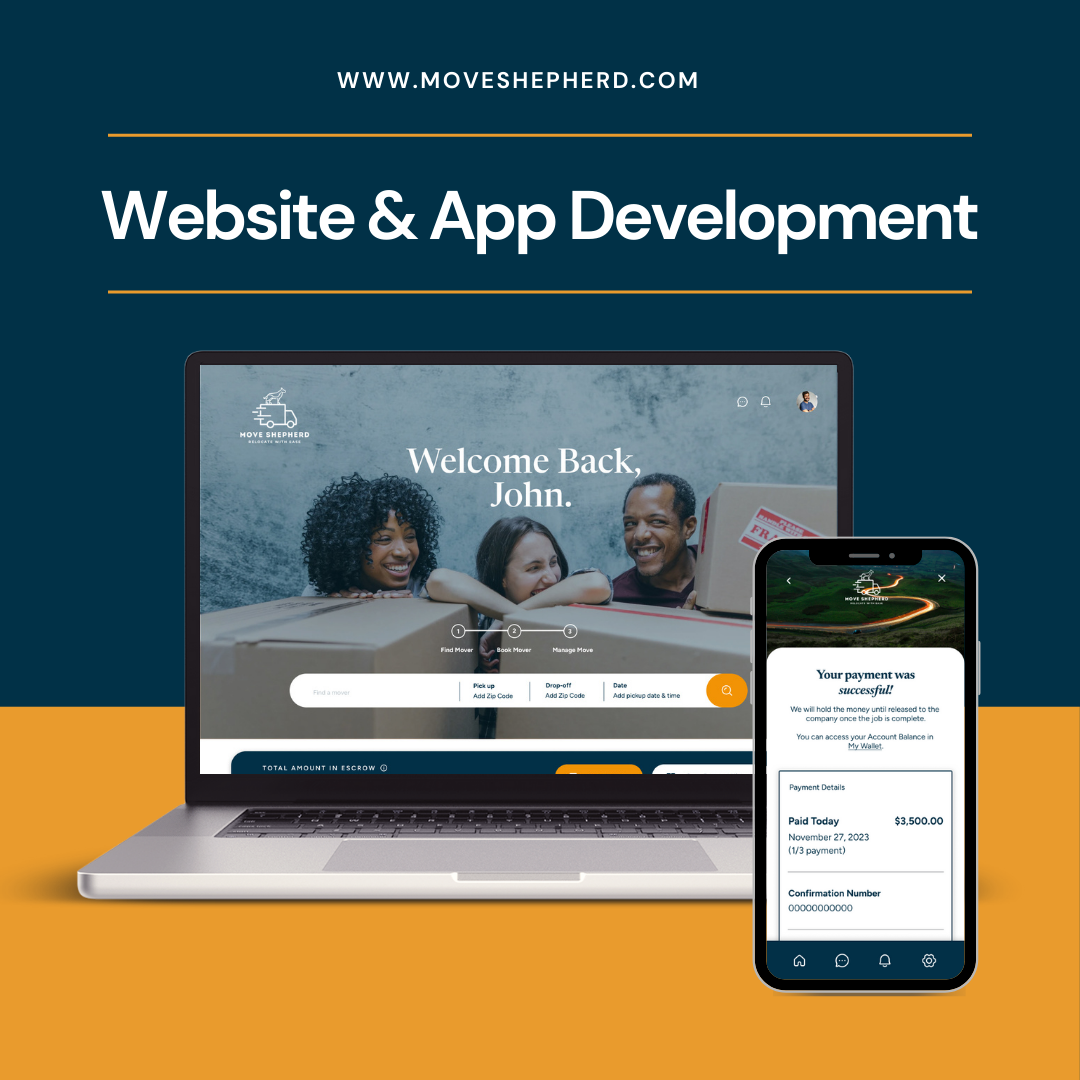
After validating the initial prototype, the platform entered nearly a full year of iterative refinement. Each cycle focused on eliminating friction in the core workflows that mattered most to both movers and clients. Through continuous usability testing and feedback synthesis, the insights were translated into tangible platform improvements. The areas of imporvement included:
✺ Platform confirmation feedback
✺ Payment management & milestone editing
✺Communication accessibility and consistency
✺ Misleading terminology
✺ Navigation fixes
%20(1).png)

Looking back at this project with more experience, what stands out is how much I learned by leading both the UX and service-design work on my own over two years. It was my first large-scale platform, and while the result set a strong foundation for development, the process also revealed clear areas for improvement.
At the time, my approach was heavily shaped by my UX studies. If I were doing this today, I would bring a stronger systems perspective from the start—mapping stakeholders, operational flows, and industry constraints before moving into interface design. I would also be far more rigorous in how I documented insights, decisions, and assumptions. Working alone pushed me toward speed and iteration, but in hindsight, clearer traceability would have strengthened the handover and long-term strategy.
Even so, the project gave me significant autonomy and helped me build confidence in navigating ambiguity, aligning with leadership, and defining a product vision independently. It marked an important shift in my practice: toward more critical thinking, deeper framing, and a more mature understanding of how service design operates beyond academic theory.
~ Daniella de Rijke Rodríguez, December 2025.
A set of practical reflective tools for building municipal capability to embed spatial justice in climate-neutral planning.